· Alex @Leazehub · Property Management Software · 13 min read
From Spreadsheet Chaos to an All-in-One Solution: Why We Built LeazeHub
A property manager's journey from juggling spreadsheets, QuickBooks, and multiple apps to building LeazeHub—an affordable all-in-one platform for independent landlords and boutique managers...
From Spreadsheet Chaos to an All-in-One Solution: Why I Built LeazeHub
The Juggling Act of a Property Manager
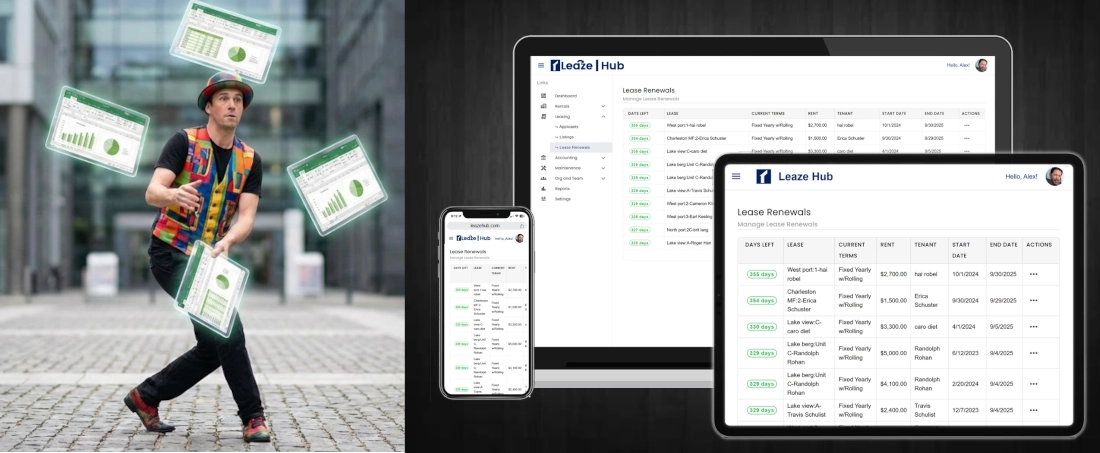
When I became a property manager managing a handful of units, I didn’t think I needed fancy software. I started with the basics: spreadsheets, a bookkeeping app, and my phone. Before long, though, I was drowning in a patchwork of tools. Every task had a different app or method, and nothing talked to each other. If you’re a property manager, this might sound familiar – it’s a lot to juggle.
Here’s what my “system” looked like at one point:
Rent tracking: I logged payments in Excel spreadsheets (basically free, but incredibly time-consuming and prone to error)[1]. There were no automatic rent reminders or receipt tracking – just me, manually updating cells.
Accounting: I tried QuickBooks to track income/expenses. It’s great for general bookkeeping, but it has almost no rental-specific features – I still had to manage tenants, leases, and maintenance outside of it[2]. In other words, accounting was one app, and property management was another (or several others).
Tenant communication & maintenance: There was no central portal, so everything was done through phone calls, texts, and emails. I’d get maintenance requests via a late-night text, scribble notes on paper, and hope I didn’t lose track. Not exactly efficient – especially since most tenants today expect digital convenience (over 72% of renters prefer digital communications, and 80% prefer paying rent online)[3].
Lease signing: Getting a lease signed meant either meeting in person or using a separate e-signature service. I remember thinking how absurd it was to pay extra just to sign a PDF – but what choice did I have? It was another workaround, and another account to manage.
This cobbled-together approach was stressful. I was constantly switching between apps and spreadsheets, and things still slipped through the cracks. Worse, I felt my workflow was stuck in the stone age while larger property managers had slick all-in-one systems. I needed that kind of efficiency too, but without the big price tag.
Why Other Software Fell Short
Naturally, I started exploring property management software to rescue me from the chaos. Unfortunately, most tools felt like misfits for a small portfolio like mine:
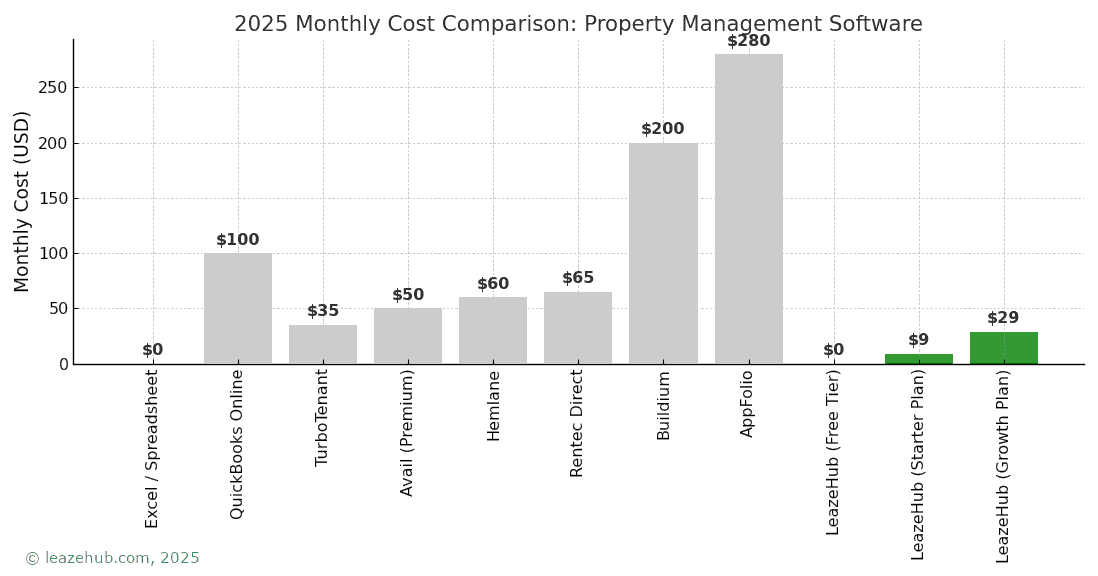
Big Professional Platforms – Too Pricey and Complex: I looked at well-known solutions like Buildium and AppFolio, which many professional managers use. Yes, they’re powerful – but they’re built (and priced) for large operations. Buildium, for example, often starts around $200 per month and can go beyond $300 for the premium packages[4]. AppFolio requires around a $280 monthly minimum even if you have only a few dozen units[4]. That’s overkill for someone with 10 or 20 units. Not to mention, when I trialed one of these, I found myself tangled in features and settings meant for apartment complexes or big management firms. I just wanted to collect rent and handle repairs, not configure accounting modules for each client owner. It felt like using a sledgehammer on a thumbtack.
“Freemium” Property Management Apps – Costs Add Up: Next I tried the popular apps targeting independent property managers, like Avail and TurboTenant. They advertise a lot of free features, and that’s true to a point. But I quickly hit the limits of the free plans. The features I actually needed (online lease signing, automated rent reminders, ACH payments) were “premium” and came at a per-unit price. Avail, for instance, was free for basic use, but if I wanted things like automated payments or e-signatures, it would run about $5–$9 per unit each month[5]. That doesn’t sound like much until you do the math: with, say, 10 units, I’d be paying roughly $70 extra every month for those add-ons. Suddenly the “free” tool could cost as much as a car payment. This piecemeal pricing — a few dollars per unit here, small fees there — felt like death by a thousand cuts. I also noticed some of these apps would nickel-and-dime you with transaction fees or “premium” customer support tiers[6]. In short, the simplicity and savings they advertised didn’t fully materialize once you scaled beyond a couple of units or wanted the full feature set.
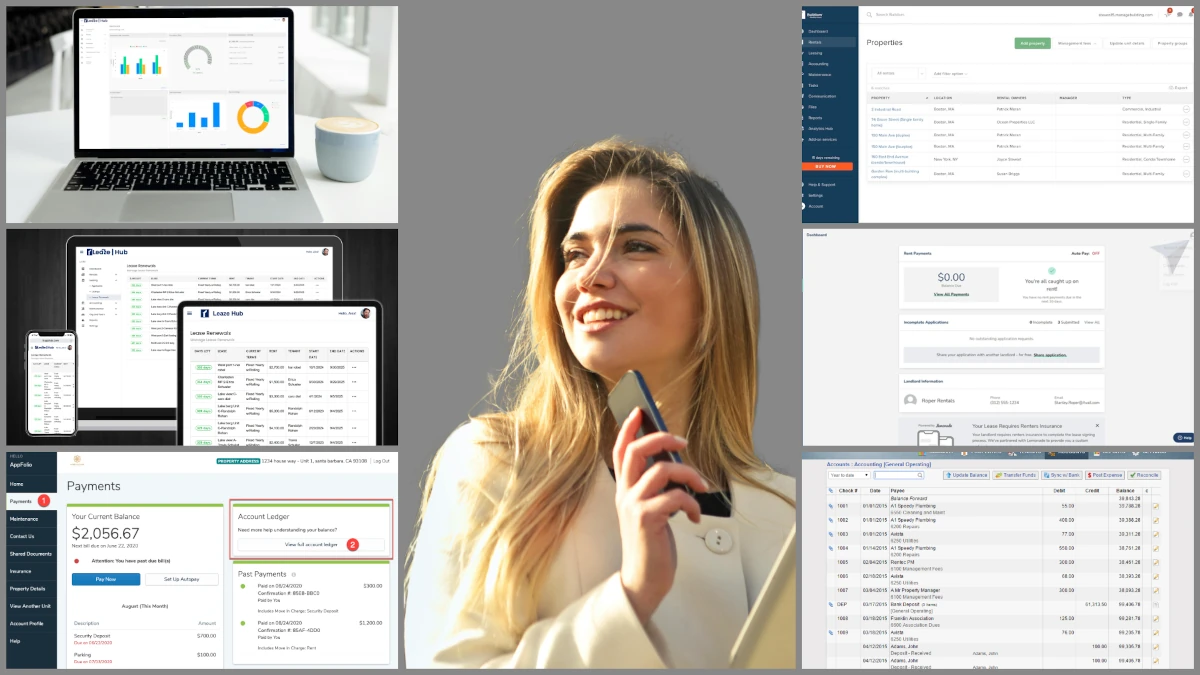
Other Mid-tier Options – Still Not One-and-Done: I considered mid-range products like Hemlane, Rentec Direct, and a newer entrant, RentRedi. They aim to strike a balance, but often you still face either complexity or extra steps. Hemlane and Rentec offer a mix of a base subscription plus per-unit fees, which can “add up quickly” as you grow[6]. And while RentRedi impressed me with an affordable flat fee for unlimited units, I discovered I’d still need to use additional software alongside it. For example, RentRedi’s built-in accounting is pretty basic – they actually integrate with a partner (REI Hub) for more advanced accounting tasks[7]. That means if you want full bookkeeping, you’re back to managing two systems (RentRedi + an accounting tool). For me, that defeated the purpose of an all-in-one solution. I didn’t want to “integrate with” QuickBooks or another service – I wanted to eliminate the extra logins entirely.
In the end, I couldn’t find a single product that met my needs as an independent property manager. The high-end platforms were too costly and complex, and the lightweight apps either weren’t truly all-in-one or became expensive as you unlocked features. It became clear that the gap in the market was real – in fact, it’s noted that there’s a significant gap between large-scale property management companies and the independent property managers with portfolios[8]. I was living that gap. So, I decided to fill it.
Building a Lean, All-in-One Solution
Frustrated by the lack of a perfect fit, I did something a bit crazy: I set out to build the tool I wanted. That project became LeazeHub – a budget-friendly, all-in-one property management and accounting platform designed for property managers like me. I wasn’t a software tycoon or anything, just a property manager who knew what he needed. And what I needed was pretty straightforward on paper: one app that could do the work of five.
LeazeHub is my attempt to centralize all the key tasks of property management in one place. It combines online rent collection, maintenance requests, lease e-signing, and full bookkeeping in a single, simple dashboard[9]. No more hopping between different services and spreadsheets – the platform handles the whole workflow end-to-end[10].
To break it down, with one login I can now:
Collect Rent Online: Tenants pay through the LeazeHub portal (ACH or card), and it logs the payment automatically. No more chasing checks or manually updating ledger entries. Rent goes straight into my account and I get notified, with a clear record for both me and the tenant.
Manage Maintenance Requests: Tenants can submit maintenance issues online (even attach photos). I track all requests in LeazeHub, assign them to my handyman, and update the status so the tenant isn’t left in the dark. It’s all documented. I’m not digging through text messages to remember if Unit 2’s leaky faucet was fixed – it’s recorded in the system.
Sign Leases Digitally: LeazeHub has built-in electronic lease signing. I upload my lease, send it to the tenant for e-signature, and we’re done. There’s no extra charge for unlimited e-signatures or storage – it’s included[11]. This was huge for me, because some services (even big-name software) charged per e-sign or capped how many documents I could send. Now, whether I’m signing one lease a year or twenty, I don’t worry about extra fees.
Keep the Books in Order: Every rent payment, fee, and expense is tracked in the same system. LeazeHub has a full general ledger and reporting built-in. At tax time, I can generate income/expense reports per property without exporting to another program. Since the accounting is integrated, I no longer need a separate QuickBooks subscription on the side[12]. It even handles things like splitting expenses between multiple owners or generating owner statements if you have partners/investors (features that were missing from my old setup).
LeazeHub provides a unified dashboard accessible on any device, so I can manage my rentals from my laptop at home or my phone on the go. It’s designed to be user-friendly for busy property managers without an IT department.
From day one, I aimed to make LeazeHub approachable. I remember how intimidating some software demos felt, with tech jargon and complex menus. In contrast, I built this as a fellow property manager, not a Silicon Valley engineer. If you can use basic online banking, you can navigate LeazeHub. (Heck, my most “tech-challenged” friend is using it for his four-unit rental, which I consider a victory!). My guiding principle was to give independent property managers the same efficiencies that big property managers enjoy but without the complexity or inflated costs of those big systems[13]. I think that human touch – designing it for myself and people like me – makes it feel different from the cookie-cutter corporate software out there.
Flat Pricing, No Surprises
Another thing I knew from experience: budgeting for software can be a nightmare when pricing isn’t clear. I’ve seen platforms that look cheap, then hit you with add-on fees for extra features, users, or even for sending out emails. I was determined that LeazeHub’s pricing would be simple and transparent – the kind of pricing I would want as a customer.
LeazeHub uses flat pricing based on portfolio size, with no per-unit fees or hidden add-ons[14]. In fact, we even offer a free tier for folks with 1–5 units. I felt strongly that if you’re a brand-new property manager with just a couple of tenants, you should have access to all the core tools at no cost to get you started. That free plan includes the same core features – yes, online rent payments, maintenance tracking, e-signatures, full accounting, multi-user access, etc., are all included even in the free version[14]. There’s no bait-and-switch where you discover e.g. digital leases cost extra – they don’t. Tenants can use their portal for free; if you have an owner/investor who wants access, that’s free for them too[11]. I don’t ever want users to feel nickel-and-dimed.
For those with more units, the next step up is the Starter plan at $9/month for up to 20 units[14]. Again, that’s $9 flat – not $9 per unit. For under ten bucks, a property manager can run their entire operation without worrying about limitations. And as your portfolio grows, the pricing moves in reasonable increments. The plan for up to 100 units is $29/month, and there’s an unlimited plan at $99 if you ever scale to that level. The idea is that you can plan your expenses easily. Whether you’re managing 10 units or 50 units, you know what you’ll pay, and it’s a fraction of what the traditional software would cost. In other words, LeazeHub uses “flat, no-surprises pricing that grows with your portfolio without blowing the budget.”[15]
Importantly, there are no surprise fees along the way. For example, we don’t charge extra transaction fees for standard ACH rent payments – those are just part of the service. We don’t limit your number of users or charge you if you want to add, say, your business partner or a property owner to view reports. Need to store a bunch of lease PDFs or receipts? Go for it – we’re not going to meter your storage or slap a “per report” fee on you[11]. I hated those kinds of nickel-and-dime charges in other tools, so we simply don’t have them. The price you pay is the price to get all the features for your size of portfolio, period.
To put this in perspective, I’ll gladly take a flat $9 or $29 a month solution that covers everything over a “cheaper” looking software that ends up charging per tenant, per lease, per payment, etc. If I ever felt tempted to cut corners and go back to a mishmash of “free” tools, I remind myself how quickly those can end up costing more in both time and money. With LeazeHub, I wanted fellow property managers to know they’re getting an awesome value – no more worrying that growth will suddenly trigger a huge software bill or that an essential feature lies behind a paywall.
Built for Independent Property Managerss, by One
Ultimately, LeazeHub exists because I was a property manager who got fed up with the status quo. I figured I couldn’t be the only one out there facing these pains. And I was right – there’s a whole community of independent property managers and boutique property managers who have been stuck between clunky spreadsheets and overpriced software. LeazeHub tries to fill that void by offering a solution that’s truly made for our scale and needs[16][10]. We don’t have 24/7 IT departments or massive budgets, and we shouldn’t need them just to keep our rentals running smoothly.
The feedback so far has been incredibly encouraging. One property manager told me that using LeazeHub was like “finally upgrading from a flip phone to a smartphone” for his rentals – everything became easier to handle, and he wondered why he hadn’t done it sooner. That kind of comment makes my day, because it means the product is doing what I set out for it to do: simplify life for landlords and property managers.
In creating LeazeHub, I kept reminding myself of the core values I cared about: simplicity, affordability, and end-to-end functionality for the independent property manager[10]. No fluff, no corporate buzzwords – just the tools that matter, designed in a way that normal people can use, at a price that makes sense even if you only have a few units. It’s literally built by a property manager, for property managers.
I know this turned into a bit of a story, but I hope it gives you insight into why I built LeazeHub and how it might help you. If you’re a landlord or a property manager feeling the same frustrations I had, just know that there are solutions now that were made with you in mind. Whether you try LeazeHub or another platform, don’t settle for juggling five different apps and stressing over the small stuff. You and your tenants deserve better.
For me, it’s been a game-changer to log into one dashboard and see everything – from whose rent is late to which maintenance tickets are open and how the income/expenses are looking this month. I finally feel on top of things, without burning hours on administrative tasks. And that’s really the whole point: to spend less time shuffling papers (or spreadsheets) and more time growing my investment – or heck, enjoying a free weekend for once!
(Feel free to reach out if you have questions about LeazeHub – as a founder who’s also a user, I’m always happy to share what I’ve learned.)
[1] [2] [5] [12] How Much Does Property Management Software Cost?
https://leazehub.com/how-much-does-property-management-software-cost
[3] [4] [6] [8] [9] [10] [11] [13] [14] [15] [16] Independent Landlords and Boutique Property Managers Adopt LeazeHub as Demand for Property Management Software Surges
[7] RentRedi vs Buildium: Which Is Right for You in 2025? | Buildium